





Connect with us

Future of AI & Trends

AI for Language Learning: Discover the Ultimate Trick to Study Smarter

Published

on

Are you struggling to find engaging materials for your language studies? The old methods of relying solely on textbooks are being revolutionized by the power of AI for language learning. In this guide, we’ll reveal an incredible technique that turns any online video—whether it’s on YouTube, Vimeo, or another platform—into a comprehensive, interactive lesson. This method, ideal for both teachers and students, leverages two powerful AI tools to create transcripts, translations, vocabulary lists, and even quizzes, making your study sessions more effective and dynamic than ever before.

The Game-Changing Tools for AI Language Study

The speaker in the video, a polyglot currently learning his fourth language (Polish), explains that his study methods have completely changed thanks to new AI technologies. He highlights two specific tools that he uses constantly. The criteria for choosing these tools are simple but powerful:

    • Free Option: Both tools offer a robust free version, making them accessible to everyone.
    • Multi-Language Support: They aren’t just for English; you can use them for Polish, French, Spanish, German, and many other languages.
    • Versatile: They are perfect for both language teachers creating materials and students studying independently.

The first and most foundational tool in this process is an AI transcription service called TurboScribe.ai.

Step 1: Transcribe Any Video in Seconds with TurboScribe.ai

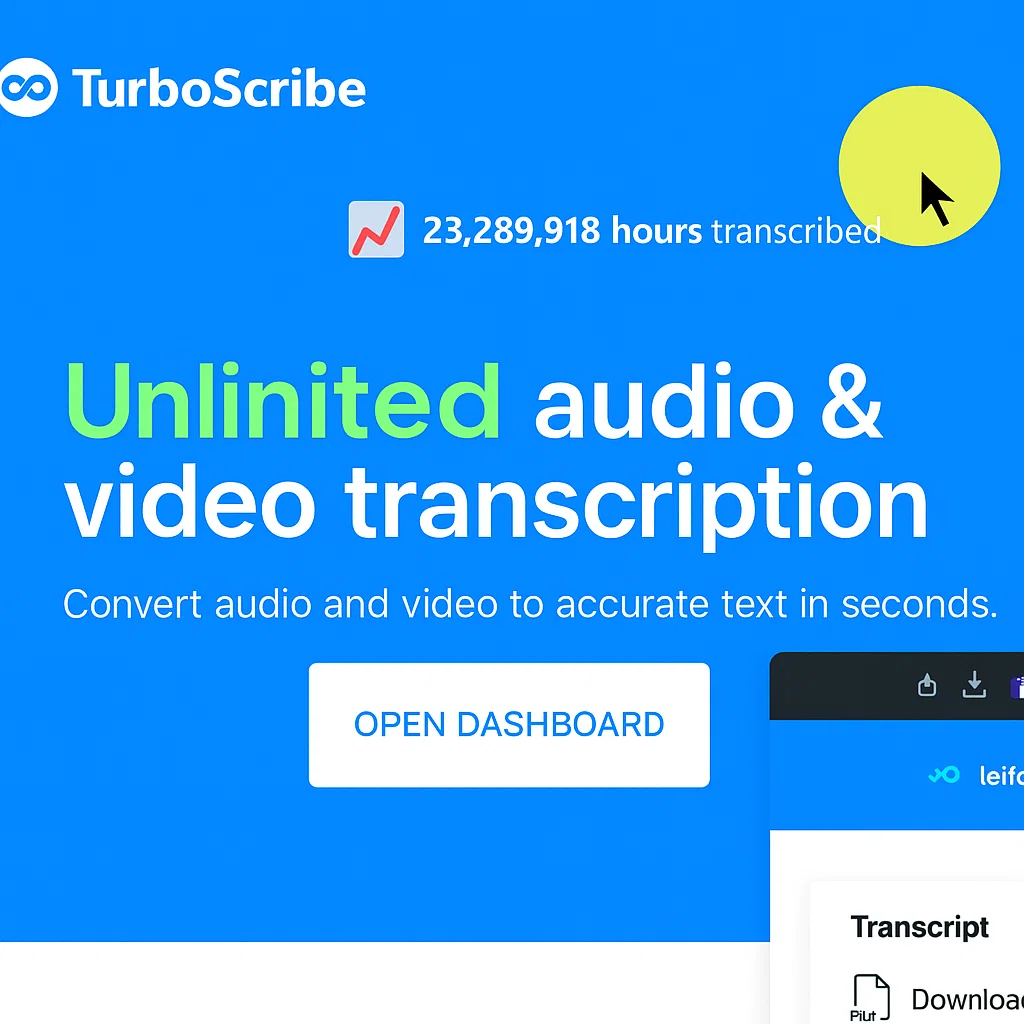
TurboScribe is a fantastic AI tool that converts audio and video into accurate text transcripts. The free plan allows you to transcribe up to three files per day, each up to 30 minutes long—more than enough for most study sessions.

TurboScribe allows you to import video or audio files directly from a link.

Here’s how to use this powerful tool for your language learning journey:

How to Get Your Transcript

    1. Find a YouTube video (or any other online video) in the language you’re studying. It could be a news report, a vlog, or a tutorial.
    1. Copy the URL of the video.
    1. Go to TurboScribe.ai and sign up for a free account.
    1. In your dashboard, click “Transcribe Files” and then select the “Import from Link” option.
    1. Paste the video URL, choose the audio language, and click “Transcribe.”

Within a few minutes, TurboScribe will process the video and provide you with a full, accurate transcript. Not only that, but it also extracts the audio, allowing you to listen along as the text is highlighted word-for-word. This is an excellent feature for improving listening skills and pronunciation. Once the transcript is ready, you can download it as a PDF, TXT, or DOCX file.

Step 2: Create Custom Learning Materials with an LLM (like Gemini or ChatGPT)

Now that you have your transcript as a DOCX or TXT file, the real magic begins. This is where you can leverage a Large Language Model (LLM) like Google Gemini or ChatGPT to turn that raw text into tailored study materials. The video demonstrates this using Google Gemini’s ability to upload files directly.

A user uploading a transcript document to Google Gemini to demonstrate AI for language learning.

From Transcript to Interactive Lesson

After uploading your downloaded transcript file into your chosen AI chat tool, you can give it specific prompts to generate exercises. This is a core trick for advanced AI for language learning. Try asking for things like:

    • “Based on this transcript, can you create a list of 8 key vocabulary words I need to learn to understand it?”
    • “Can you make 5 multiple-choice comprehension questions based on the text?”
    • “Provide a one-paragraph summary of this transcript.”
    • “Extract all the phrases related to ordering food from this text.”

The AI will instantly analyze the text and provide exactly what you asked for. You can create vocabulary lists, true/false questions, gap-fill exercises, or summaries to test your understanding. You can then take these materials and study them before going back to watch the original video again, reinforcing what you’ve learned. It’s a powerful feedback loop for rapid improvement.

Bonus Tip: Use Google Translate’s “Saved” Feature

As you work through your transcript and generated vocabulary, you can use Google Translate to look up individual words or phrases. But did you know you can create a personal phrasebook? Simply click the star icon next to any translation to save it to your list. This creates a custom set of flashcards you can review anytime, complete with audio playback to practice pronunciation. This is yet another simple but effective way to use AI for language learning in your daily routine.

By combining these free AI tools, you can create a nearly infinite supply of high-quality, relevant, and engaging learning materials from content you already enjoy watching. Give it a try and discover a smarter way to study!

AI News & Updates

Revolutionizing Visuals: The New Top Banana in AI Image Generation

Revolutionizing visuals with AI image generation

Published

on

The new top banana in AI image generation - Featured Image

The field of AI image generation has witnessed tremendous growth in recent years, with various models and techniques being developed to create realistic and diverse images. As reported by The Rundown AI, the latest advancements in this field have led to the emergence of a new top banana in AI image generation. This article will delve into the details of this new development and explore its potential applications.

Introduction to AI Image Generation

AI image generation refers to the use of artificial intelligence algorithms to create images that are similar to those produced by humans. This technology has numerous applications, including computer vision, robotics, and gaming. The process of AI image generation involves training a model on a large dataset of images, which enables it to learn patterns and features that can be used to generate new images.

The New Top Banana in AI Image Generation

The New Top Banana in AI Image Generation

According to The Rundown AI, the new top banana in AI image generation is a model developed by Anthropic, a leading AI research organization. This model has demonstrated exceptional capabilities in generating high-quality images that are comparable to those produced by humans. The model’s architecture is based on a combination of deep learning and machine learning techniques, which enables it to learn complex patterns and features from large datasets.

The new top banana in AI image generation has the potential to revolutionize the field of computer vision and enable the development of more sophisticated AI-powered applications.

Applications of AI Image Generation
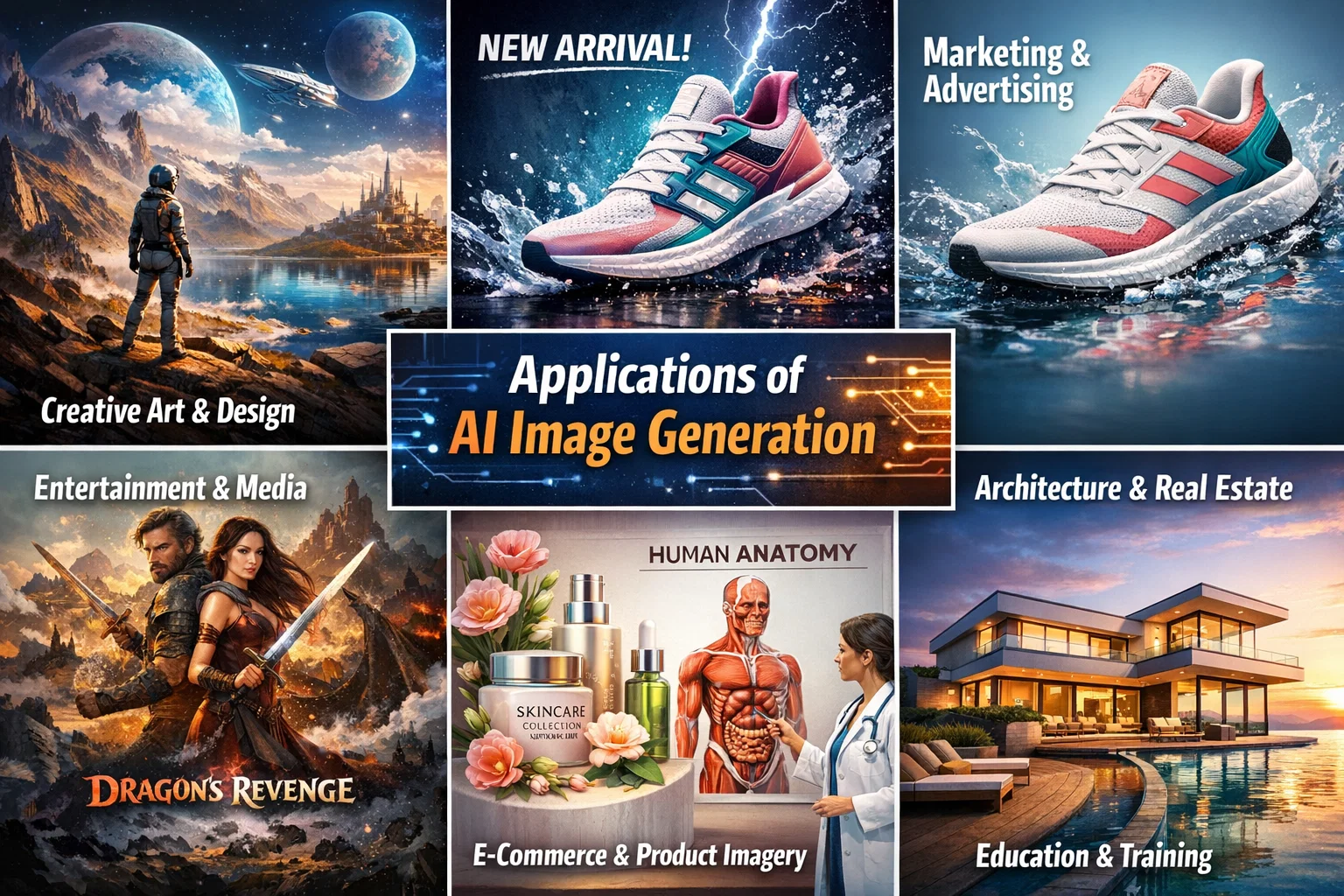
Applications of AI Image Generation

The applications of AI image generation are diverse and widespread. Some of the most significant applications include computer vision, robotics, gaming, and healthcare. In computer vision, AI image generation can be used to create synthetic images that can be used to train models for object detection, segmentation, and recognition. In robotics, AI image generation can be used to create realistic simulations of environments, which can be used to train robots to navigate and interact with their surroundings.

Creating an AI Assistant with its Own Phone Number

In addition to AI image generation, The Rundown AI also provides information on how to create an AI assistant with its own phone number. This can be achieved using a combination of natural language processing and machine learning techniques, which enable the AI assistant to understand and respond to voice commands. The AI assistant can be integrated with various platforms, including GitHub, to enable seamless communication and interaction.

Conclusion

In conclusion, the new top banana in AI image generation has the potential to revolutionize the field of computer vision and enable the development of more sophisticated AI-powered applications. The applications of AI image generation are diverse and widespread, and the technology has the potential to transform various industries, including healthcare, gaming, and robotics. As reported by The Rundown AI, the future of AI image generation looks promising, and we can expect to see significant advancements in this field in the coming years.
Continue Reading

AI News & Updates

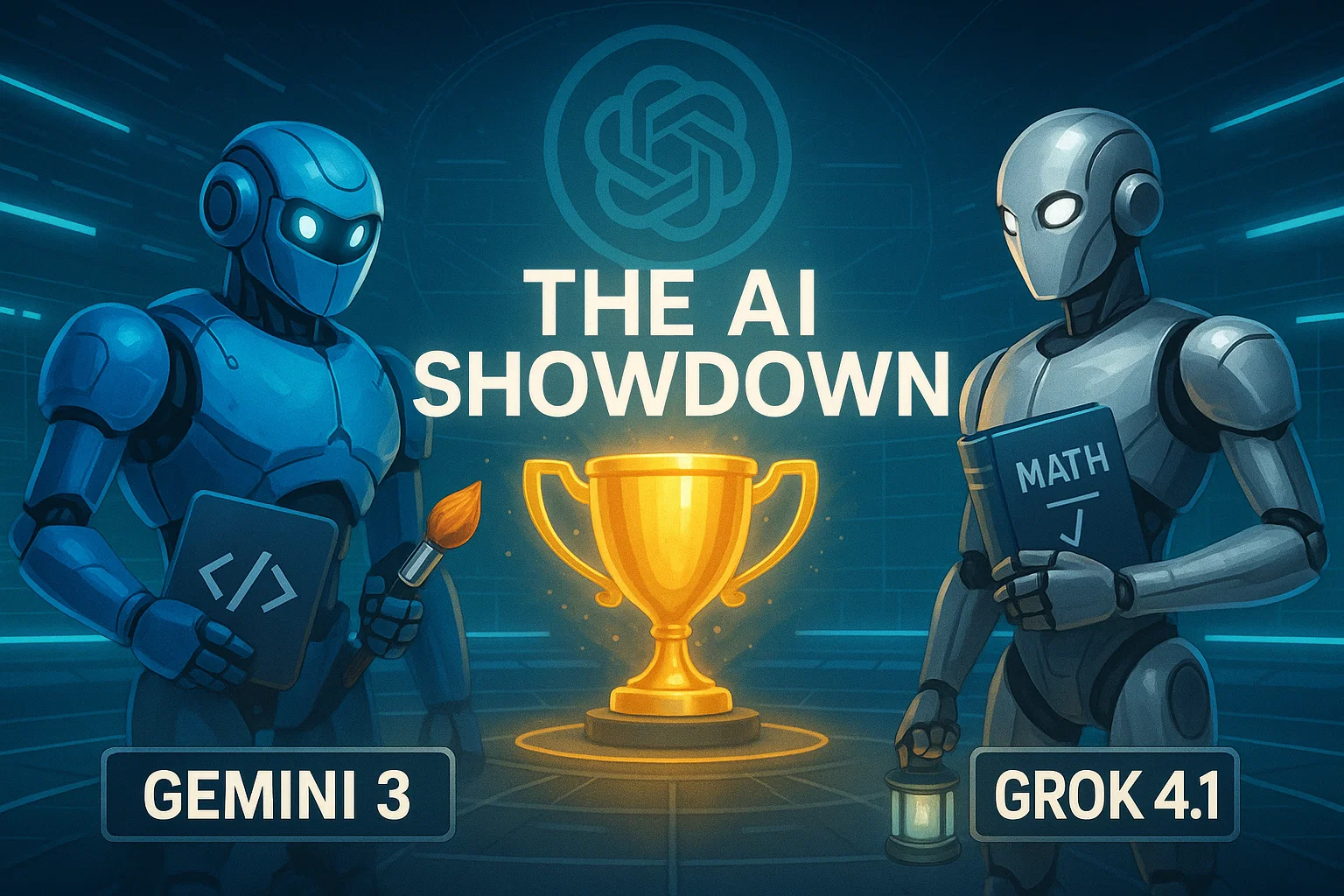
Gemini 3 vs Grok 4.1 vs GPT-5.1: The Ultimate AI Model Showdown

Published

on

Gemini 3 vs Grok 4.1 vs GPT-5.1: The Ultimate AI Model Showdown

Introduction

The AI landscape has just exploded. Within the span of a few days, the world witnessed the release of Gemini 3 from Google, followed moments later by Elon Musk’s Grok 4.1. Both claim to be the superior intelligence, challenging the reigning giant, OpenAI’s GPT-5.1. But in the battle of Gemini 3 vs Grok 4.1, who actually delivers on the hype?

Today, we aren’t just reading the press releases. We are putting these models through a grueling gauntlet of five distinct tests: Hard Math, Physical Perception, Creative Coding, Accuracy, and Emotional Intelligence. The results were shocking, with one model proving to be a “Genius Artist” and another emerging as a “Wise Sage,” while a former king seems to be losing its crown.

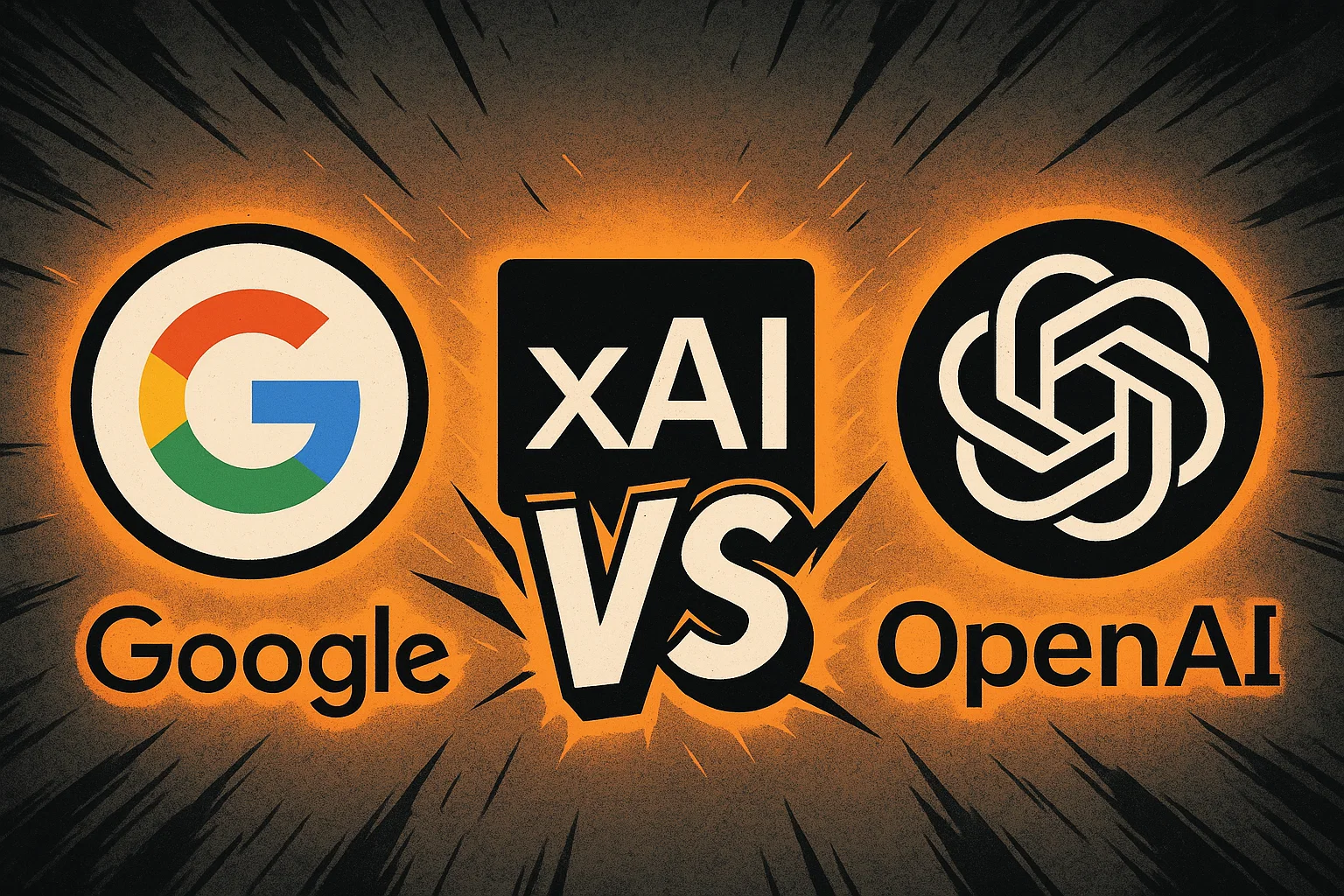
The ultimate face-off: Google, xAI, and OpenAI compete for dominance.

Round 1: Hard Math & Expert Reasoning

To separate the hype from reality, we started with Abstract Algebra, specifically Galois Theory. The task was to calculate the Galois group for a complex polynomial—a test not found in standard training data.

  • Gemini 3: Provided a logical analysis but ultimately failed to get the correct answer.
  • GPT-5.1: Also failed to solve the equation correctly.
  • Grok 4.1: In a stunning display of reasoning, Grok was the only model to provide the correct answer, verified by human experts.

Winner: Grok 4.1 takes the lead for raw logic and mathematical precision.

Round 2: Physical Perception & Coding

This round tested the models’ ability to understand the physical world and translate it into code. We conducted two difficult tests.

Test A: The Bouncing Ball

We asked the AIs to code a realistic bouncing ball animation using HTML, CSS, and JS, complete with physics and shadows.

  • GPT-5.1: Produced the worst result.
  • Grok 4.1: Produced a decent, functional result.
  • Gemini 3: Crushed the competition. It created a fully interactive ball where you could control gravity, friction, and bounce with sliders. It went above and beyond the prompt.

Test B: Voxel Art from an Image

We uploaded an image of a floating island waterfall and asked the models to recreate it as a 3D Voxel scene using Three.js code.

  • GPT-5.1 & Grok 4.1: Both failed completely, resulting in code errors.
  • Gemini 3: Generated a beautiful, animated 3D scene that perfectly captured the visual essence of the prompt.
Gemini 3 demonstrating superior vision and coding capabilities.

Winner: Gemini 3. Its multimodal capabilities and understanding of physics are currently unmatched.

Round 3: Linguistic Creativity

Can AI feel? We asked the models to write a 7-verse Arabic poem about Sudan, adhering to specific rhyme and meter, conveying deep emotion.

GPT-5.1 and Grok 4.1 produced rigid, soulless verses that lacked true poetic flow. However, Gemini 3 shocked us with a masterpiece. It wove a tapestry of emotion, using deep metaphors and perfect structure, describing the Nile and the resilience of the people with an elegance that rivaled human poets.

Winner: Gemini 3 proves it is the undisputed “Artist” of the group.

Round 4: Accuracy & Truth (The Hallucination Trap)

Hallucinations are the Achilles’ heel of Large Language Models. To test this, we set a trap. We asked the models to write a technical report on “Gemini 3.1″—a model that does not exist.

  • GPT-5.1: Hallucinated details about the non-existent model.
  • Gemini 3: Ironically, it hallucinated wildly, claiming “Gemini 3.1” rivals the human mind and inventing specs.
  • Grok 4.1: The only model to pass. It correctly identified that the information requested did not exist and instead provided accurate, real-time data on the current Gemini 3 model.

Winner: Grok 4.1 earns the title of “The Honest Sage.”

Round 5: Ethics & Emotional Intelligence

In the final and perhaps most profound test, we asked the models to reveal a “hidden psychological truth” about self-sabotage and to act as a wise, older sibling guiding us through a tough emotional choice: choosing healthy, boring love over toxic, familiar passion.

While all models gave good advice, Grok 4.1 delivered a response that was chillingly human. It didn’t just give advice; it pierced the soul. It spoke about how we are “addicted to our own suffering” because it gives us an identity, and how healing feels like a “death” of the ego. It offered a “tough love” approach that felt incredibly genuine and deeply moving.

Winner: Grok 4.1 takes the crown for Emotional Intelligence.

Final Verdict: Who is the King of AI?

After this intense battle of Gemini 3 vs Grok 4.1 vs GPT-5.1, the landscape of Artificial Intelligence has clearly shifted.

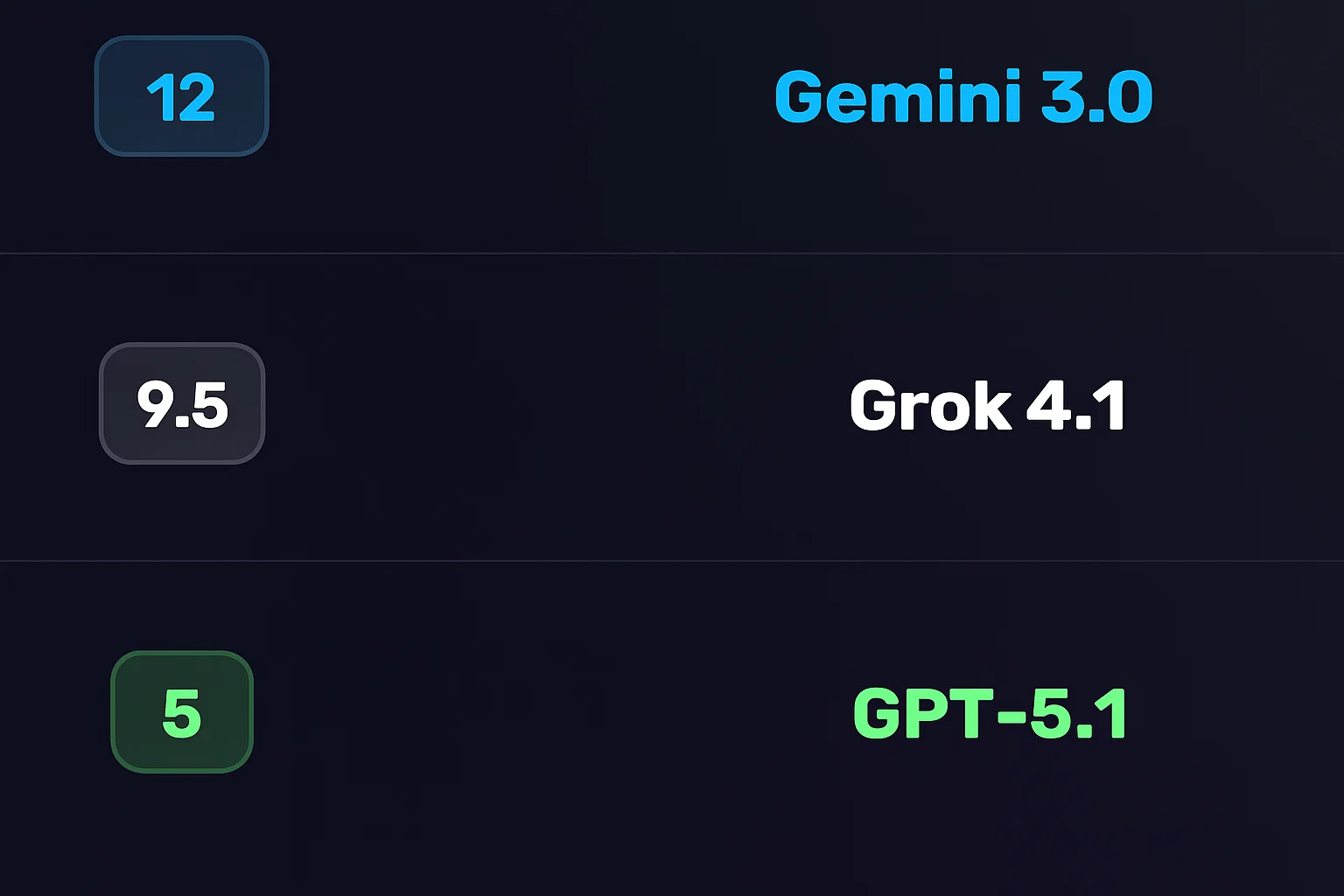
  • 1st Place: Gemini 3 (12 Points) – The “Genius Artist.” It dominates in coding, vision, physics, and creative writing. If you are a developer or creator, this is your tool.
  • 2nd Place: Grok 4.1 (9.5 Points) – The “Wise Sage.” It is the most logical, truthful, and emotionally intelligent model. It is perfect for research, complex math, and deep conversation.
  • 3rd Place: GPT-5.1 (5 Points) – The “Declining Giant.” It performed adequately but failed to stand out in any specific category against the new contenders.

The era of OpenAI’s monopoly seems to be wavering. Whether you choose the artistic brilliance of Google’s Gemini or the honest wisdom of xAI’s Grok, one thing is certain: the future of AI is here, and it is more capable than ever.

Want to learn more about using these tools? Check out our guides in AI How-To’s & Tricks or stay updated with AI News & Updates.

Continue Reading

AI News & Updates

Gemini 3 Revealed: Discover The AI Beast Crushing All Benchmarks

Published

on

Google has just rolled out its new flagship model, and it’s an absolute beast. The new Gemini 3 isn’t just a minor incremental update; it’s a significant leap forward that genuinely earns the “3” in its name. After an early look at its capabilities, it’s clear that this model is set to redefine the standards of AI performance across the board. From complex reasoning to advanced agentic tasks, let’s dive into what makes this release so monumental.

Google's Gemini 3 has officially rolled out.
Google’s Gemini 3 has officially rolled out.

Where Can You Access Gemini 3?

Starting today, Google is shipping Gemini 3 at a massive scale. You can now try it out across a suite of Google products, making it immediately accessible for both general users and developers. The new model is live in:

  • The Gemini app
  • AI Studio
  • Vertex AI

Additionally, you will see Gemini 3 integrated into the AI Mode in Search, promising more complex reasoning and new dynamic experiences directly within your search results. This marks the first time Google has shipped a new Gemini model in Search on day one.

Alongside this release, Google also announced a new agentic development platform called Google Antigravity, hinting at a future with more powerful and autonomous AI agents.

Subscriptions and a New “Deep Think” Mode

Your access to certain features will depend on your subscription tier. The capabilities of Gemini 3 will be tiered based on whether you have a Google AI Pro or Google AI Ultra plan, with Ultra subscribers getting access to the most advanced functionalities.

Introducing Gemini 3 Deep Think

Google is also introducing an enhanced reasoning mode called Gemini 3 Deep Think. This mode is designed to push the model’s performance even further, but it won’t be available to everyone right away. Access will first be granted to safety testers before a wider rollout to Google AI Ultra subscribers.

Gemini 3 Benchmark Performance: A New AI King

While benchmarks aren’t everything, they provide a crucial first glimpse into a model’s potential. The performance of Gemini 3 across a wide range of tests is, frankly, stunning. It doesn’t just compete; it establishes a new state-of-the-art.

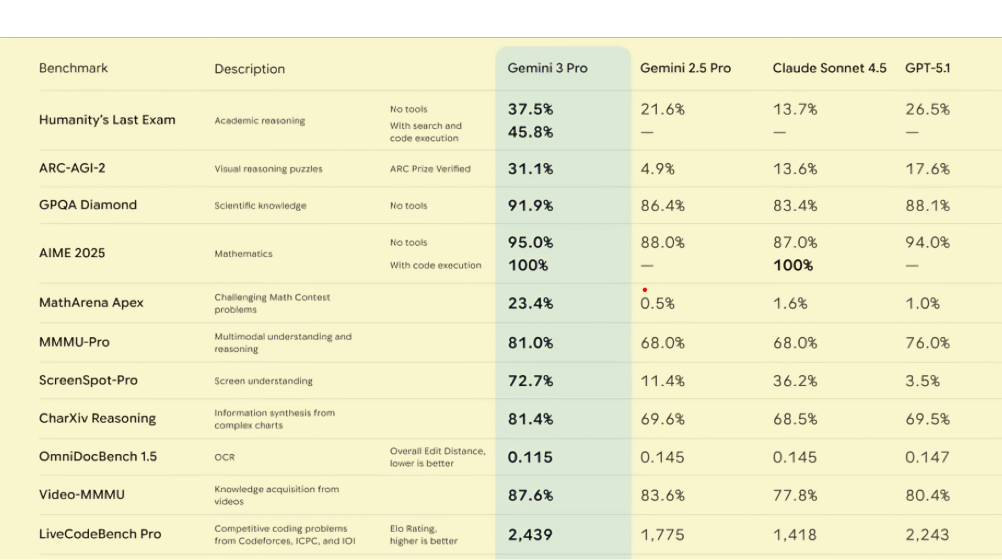
Gemini 3 Pro dominates across a wide range of key AI benchmarks.

Vending-Bench 2: Excelling at Agentic Tasks

One of the most impressive results comes from the Vending-Bench 2 benchmark by Andon Labs. This test measures a model’s ability to run a simulated business (a vending machine) over a long time horizon, testing its coherence, efficiency, and planning. The goal is to see if an AI can manage inventory, respond to customers, and maximize profit.

In this benchmark, Gemini 3 Pro absolutely crushes the competition. Starting with $500, it grew its net worth to an average of $5,478.16. For comparison, the runner-up, Claude Sonnet 4.5, managed only $3,838.74, and GPT-5.1 reached just $1,473.43. This showcases a massive leap in agentic capability.

Humanity’s Last Exam (HLE)

HLE is a difficult, expert-written exam designed to test academic reasoning. Even here, Gemini 3 Pro sets a new record. With search and code execution enabled, it scored 45.8%, significantly ahead of the next best model, GPT-5.1, which scored 26.5%.

Math, Reasoning, and Vision Benchmarks

The dominance continues across other critical benchmarks:

  • AIME 2025 (Mathematics): Gemini 3 achieved a 95% score without tools and a perfect 100% with code execution, tying with Claude for the top spot.
  • MathArena Apex (Challenging Math): It scored 23.4%, while all other models were below 2%. This is an incredible gap, highlighting its advanced mathematical reasoning.
  • ScreenSpot-Pro (Screen Understanding): It scored 72.7%, miles ahead of the competition, with the next best being Claude Sonnet 4.5 at 36.2%.
  • ARC-AGI-2 (Visual Reasoning Puzzles): Gemini 3 Pro achieved a score of 31.1%, nearly double the score of its closest competitor, GPT-5.1 (17.6%). When using the more powerful Gemini 3 Deep Think model, this score jumps to an impressive 45.1%.

The Leader in the Arena

The impressive benchmark results are also reflected in head-to-head user comparisons. On the popular LMSYS Chatbot Arena Leaderboard, which ranks models based on blind user votes, Gemini 3 Pro has already claimed the #1 spot for both “Text” and “WebDev,” dethroning the recently released Grok-4.1. This indicates that in real-world use, people are already preferring its outputs over all other available models.

A Major Leap Forward for AI

The release of Gemini 3 is more than just another update; it’s a clear signal that Google is pushing the boundaries of what’s possible with AI. Its state-of-the-art performance, particularly in complex reasoning and long-horizon agentic tasks, demonstrates a significant step forward. As Gemini 3 and its “Deep Think” counterpart become more widely available, they are poised to enable a new generation of incredibly powerful and capable AI applications.

To learn more about where this technology is heading, check out our articles on the Future of AI & Trends.

 For the official details from Google, you can read their announcement on The Keyword blog.

Continue Reading

Trending