





Connect with us

AI News & Updates

Qwen3-Coder: Alibaba’s Ultimate AI Stuns the Coding World

Published

on

Qwen3-Coder

Just when the AI community was getting acquainted with Kimi-K2, Alibaba has dropped a bombshell with its next big thing: the Qwen3-Coder. This powerful new open-source agentic code model isn’t just an incremental update; it’s a monumental leap forward, demonstrating state-of-the-art performance that challenges even the most established proprietary models from OpenAI and Anthropic.

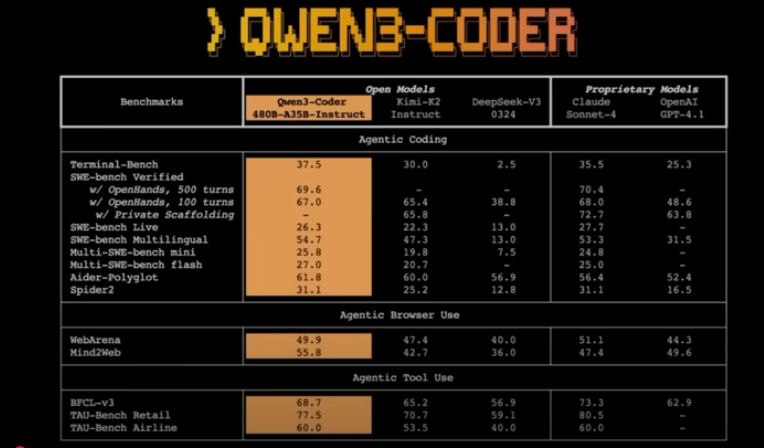
Qwen3-Coder's impressive benchmark scores compared to other leading open and proprietary models.
Qwen3-Coder’s impressive benchmark scores compared to other leading open and proprietary models.

What is Qwen3-Coder? Unpacking the Specs

Alibaba has released Qwen3-Coder in multiple sizes, but the flagship model turning heads is the Qwen3-Coder-480B-A35B-Instruct. Let’s break down what that impressive name means:

  • 480B Parameters: This is a massive 480 billion-parameter model, placing it in the upper echelon of AI model sizes.
  • Mixture-of-Experts (MoE): Despite its size, it utilizes a Mixture-of-Experts architecture. This means that during any given task, only 35 billion parameters are active, making it far more efficient than a dense model of the same size.
  • Massive Context Window: It natively supports a 256K context window and can be scaled up to an incredible 1 million tokens with extrapolation.
  • Instruct Model: This is an instruction-tuned model, designed to be a helpful, user-friendly coding assistant rather than just a raw text-completion engine.

Benchmark Breakdown: How Qwen3-Coder Stacks Up

While benchmarks should always be taken with a grain of salt, the initial results for Qwen3-Coder are nothing short of spectacular. It doesn’t just compete; it often dominates.

Performance Against Open Models

In various “Agentic Coding” benchmarks like SWE-bench, Qwen3-Coder handily beats its open-source competitors, including the recently acclaimed Kimi-K2 and DeepSeek-V3. For example, in the Terminal-Bench test, it scored 37.5, significantly higher than Kimi-K2’s 30.0 and DeepSeek’s 2.5.

Challenging the Proprietary Giants

What’s truly revolutionary is its performance against closed-source models. The benchmarks show Qwen3-Coder is:

  • Competitive with Claude Sonnet-4: In many agentic tasks, its scores are neck-and-neck with Anthropic’s latest model.
  • Beats GPT-4.1: In several key benchmarks, including SWE-bench Verified and Alder-Polyglot, Qwen3-Coder surpasses OpenAI’s GPT-4.1.

This is a significant milestone, marking one of the first times an open-source model has been shown to be directly comparable or superior to the top-tier proprietary offerings in complex, real-world coding tasks. 

This demonstrates the rapid evolution in AI technology explained on our blog

Beyond Benchmarks: Agentic Tools and Real-World Training

Alibaba didn’t just release a model; they released an ecosystem designed for practical, agentic coding.

Qwen Code: An Open-Source Command-Line Tool

Alongside the model, Alibaba has open-sourced Qwen Code, a command-line tool for agentic coding. Forked from Google’s Gemini Code, it has been specifically adapted with custom prompts and function-calling protocols to unlock the full potential of Qwen3-Coder. This tool aims to integrate seamlessly with the developer tools you already use.

Even better, the team has ensured you can use the powerful Qwen3-Coder models directly within the popular Claude Code interface, giving developers flexibility in how they work.

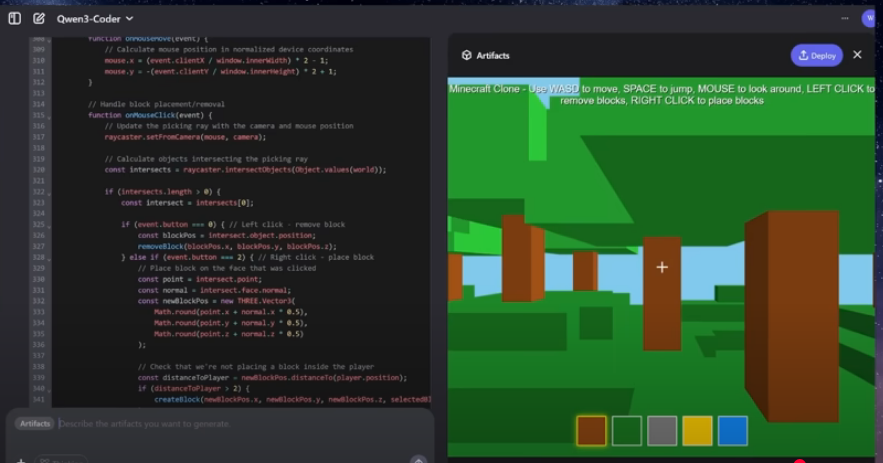
Qwen3-Coder demonstrating its ability to generate a functional Minecraft clone from a simple prompt.

A Smarter Training Philosophy

The team behind Qwen3-Coder has taken a unique approach to post-training. Instead of focusing solely on competition-level code generation, they believe all coding tasks are suited for large-scale reinforcement learning (RL). Their philosophy is “hard to solve, easy to verify.”

They trained the model on a broad set of real-world coding tasks, not just abstract puzzles. This approach significantly boosted code execution success rates and, importantly, generalized to other tasks. To achieve this, they leveraged Alibaba’s Cloud infrastructure to run a staggering 20,000 independent environments in parallel for long-horizon agent RL training.

This is a key differentiator: the model achieves its state-of-the-art performance without “test-time scaling” or complex reasoning chains at inference, making it more efficient right out of the box.

The Verdict: A New King in Open-Source AI?

The arrival of Qwen3-Coder is a landmark event for the open-source community. It provides developers with a tool that is not only free to use but also legitimately competes with and, in some cases, surpasses the performance of expensive, proprietary models. With its powerful agentic capabilities, massive context window, and intelligent real-world training, Qwen3-Coder is poised to become an essential tool for developers everywhere.

 Keep up with all the latest developments in our AI News & Updates section.

 For a deeper dive, you can explore the official announcement and resources on the Qwen Code GitHub repository.

AI How-To's & Tricks

Unlocking True Potential: Why Intelligence Should be Owned, Not Rented

Learn why owning intelligence is crucial for enterprise success

Published

on

Intelligence should be owned, not rented - Featured Image

The concept of intelligence ownership has been gaining traction in recent years, and for good reason. As Cisco has demonstrated, owning intelligence rather than renting it can be a game-changer for enterprises looking to scale their operations securely. According to a recent article by The Rundown AI, Cisco’s strategy to scale agents securely and reshape enterprise workflows is a prime example of this shift.

The Importance of Intelligence Ownership

Owning intelligence means having control over the data, algorithms, and insights that drive business decisions. This is particularly crucial in today’s fast-paced, data-driven world, where artificial intelligence and machine learning are becoming increasingly prevalent. By owning their intelligence, enterprises can ensure that their systems are secure, transparent, and aligned with their overall goals.

Scaling Agents Securely with Cisco

Scaling Agents Securely with Cisco

Cisco’s approach to scaling agents securely is centered around the idea of intelligence ownership. By developing and owning their own AI-powered agents, Cisco is able to ensure that their systems are secure, efficient, and tailored to their specific needs. This approach has allowed Cisco to reshape their enterprise workflows and improve overall productivity. As AWS and other cloud providers continue to evolve, the importance of owning intelligence will only continue to grow.

Cisco’s strategy is a great example of how owning intelligence can help enterprises scale their operations securely and efficiently. By taking control of their data and algorithms, companies can ensure that their systems are aligned with their overall goals and values.

The Benefits of Owning Intelligence

The Benefits of Owning Intelligence

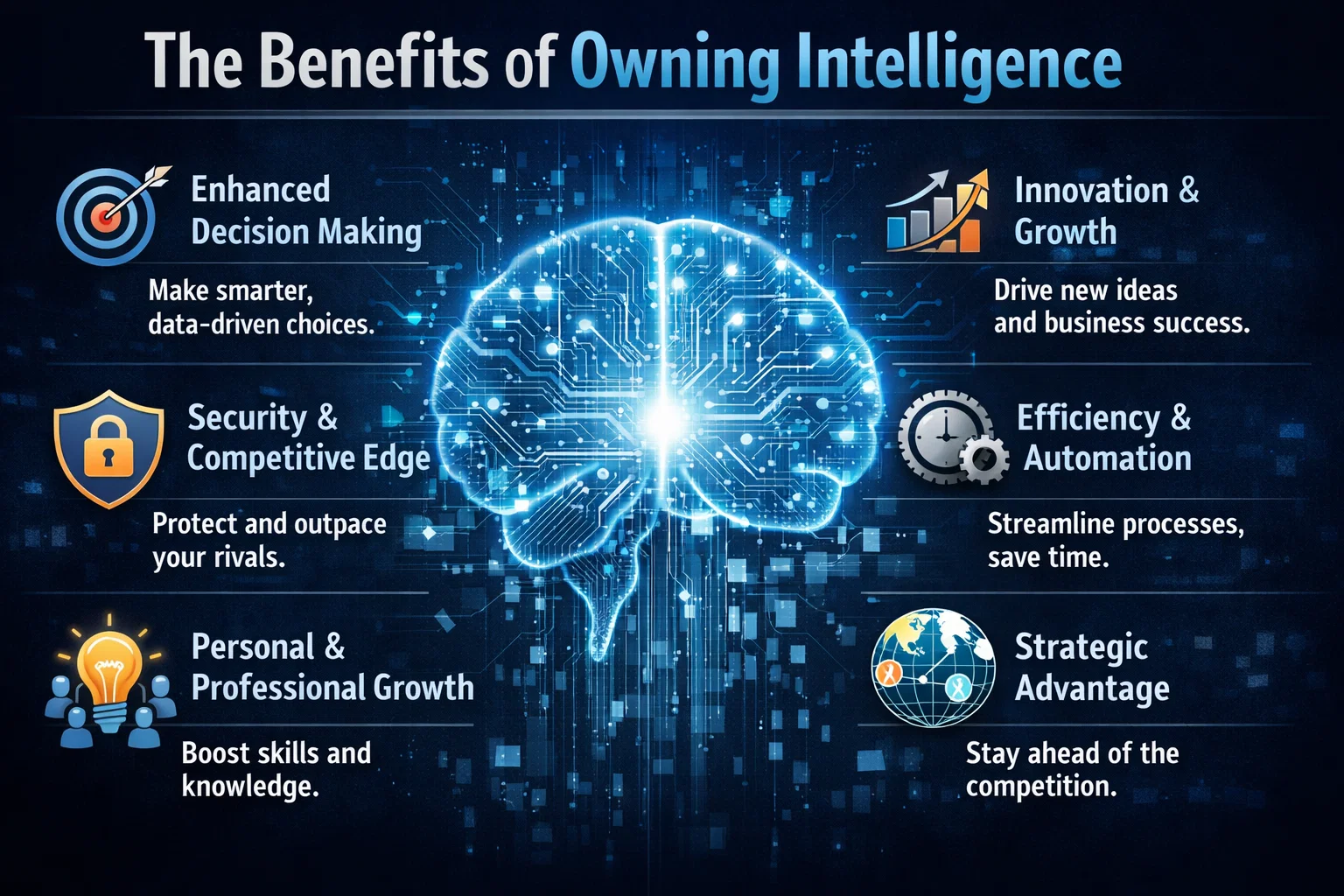
So why should enterprises prioritize intelligence ownership? The benefits are numerous. For one, owning intelligence provides a level of control and transparency that is difficult to achieve with rented intelligence. It also allows enterprises to develop systems that are tailored to their specific needs and goals, rather than relying on generic, off-the-shelf solutions. Additionally, owning intelligence can help enterprises to improve their overall security posture, as they are able to develop and implement their own security protocols and measures.

In contrast, rented intelligence can be limiting and inflexible. When enterprises rely on rented intelligence, they are often at the mercy of the provider, with limited control over the data, algorithms, and insights that drive their business decisions. This can lead to a lack of transparency, security risks, and a general sense of disempowerment.

Real-World Applications

So what does intelligence ownership look like in practice? One example is the development of custom GitHub repositories, which allow enterprises to own and control their code and data. Another example is the use of Azure and other cloud platforms to develop and deploy custom AI-powered solutions. By taking control of their intelligence, enterprises can develop systems that are tailored to their specific needs and goals, and that provide a level of security, transparency, and efficiency that is difficult to achieve with rented intelligence.

Continue Reading

AI How-To's & Tricks

Cursor Plugin Marketplace Revolutionizes AI Agents with External Tools

Extend AI agents with external tools using Cursor plugin marketplace

Published

on

Cursor launches plugin marketplace to extend AI agents with external tools- cursor.com - Featured Image

The recent launch of the Cursor plugin marketplace is a significant development in the field of artificial intelligence, enabling users to extend the capabilities of AI agents with external tools. As reported by FutureTools News, this innovative platform is set to transform the way AI agents are used in various industries. The plugin marketplace is designed to provide users with a wide range of tools and services that can be seamlessly integrated with AI agents, enhancing their functionality and performance.

Introduction to Cursor Plugin Marketplace

The Cursor plugin marketplace is an online platform that allows developers to create, share, and deploy plugins for AI agents. These plugins can be used to add new features, improve existing ones, or even create entirely new applications. With the launch of this marketplace, Cursor is providing a unique opportunity for developers to showcase their skills and creativity, while also contributing to the growth of the AI ecosystem. As mentioned on the Cursor blog, the plugin marketplace is an essential component of the company’s strategy to make AI more accessible and user-friendly.

Benefits of the Plugin Marketplace

The Cursor plugin marketplace offers several benefits to users, including the ability to extend the capabilities of AI agents, improve their performance and efficiency, and enhance their overall user experience. By providing access to a wide range of plugins, the marketplace enables users to tailor their AI agents to meet specific needs and requirements. This can be particularly useful in industries such as customer service, healthcare, and finance, where AI agents are increasingly being used to automate tasks and improve decision-making. As noted by experts in the field, the use of machine learning and natural language processing can significantly enhance the capabilities of AI agents.

Key Features of the Plugin Marketplace

Key Features of the Plugin Marketplace

The Cursor plugin marketplace features a user-friendly interface, making it easy for developers to create, deploy, and manage plugins. The platform also provides a range of tools and services, including APIs, SDKs, and documentation, to support plugin development. Additionally, the marketplace includes a review and rating system, allowing users to evaluate and compare plugins based on their quality, functionality, and performance. As stated by the GitHub community, the use of open-source plugins can significantly accelerate the development of AI applications.

The launch of the Cursor plugin marketplace is a significant milestone in the development of AI agents, and we are excited to see the innovative plugins that will be created by our community of developers. – Cursor Team

Future of AI Agents and Plugin Marketplaces

Future of AI Agents and Plugin Marketplaces

The launch of the Cursor plugin marketplace is a clear indication of the growing importance of AI agents and plugin marketplaces in the technology industry. As AI continues to evolve and improve, we can expect to see more innovative applications and use cases emerge. The use of cognitive services and conversational AI can significantly enhance the capabilities of AI agents, enabling them to interact more effectively with humans and perform complex tasks. As reported by FutureTools News, the future of AI agents and plugin marketplaces looks promising, with significant opportunities for growth and innovation.

Continue Reading

AI News & Updates

Gemini 3 vs Grok 4.1 vs GPT-5.1: The Ultimate AI Model Showdown

Published

on

Gemini 3 vs Grok 4.1 vs GPT-5.1: The Ultimate AI Model Showdown

Introduction

The AI landscape has just exploded. Within the span of a few days, the world witnessed the release of Gemini 3 from Google, followed moments later by Elon Musk’s Grok 4.1. Both claim to be the superior intelligence, challenging the reigning giant, OpenAI’s GPT-5.1. But in the battle of Gemini 3 vs Grok 4.1, who actually delivers on the hype?

Today, we aren’t just reading the press releases. We are putting these models through a grueling gauntlet of five distinct tests: Hard Math, Physical Perception, Creative Coding, Accuracy, and Emotional Intelligence. The results were shocking, with one model proving to be a “Genius Artist” and another emerging as a “Wise Sage,” while a former king seems to be losing its crown.

The ultimate face-off: Google, xAI, and OpenAI compete for dominance.

Round 1: Hard Math & Expert Reasoning

To separate the hype from reality, we started with Abstract Algebra, specifically Galois Theory. The task was to calculate the Galois group for a complex polynomial—a test not found in standard training data.

  • Gemini 3: Provided a logical analysis but ultimately failed to get the correct answer.
  • GPT-5.1: Also failed to solve the equation correctly.
  • Grok 4.1: In a stunning display of reasoning, Grok was the only model to provide the correct answer, verified by human experts.

Winner: Grok 4.1 takes the lead for raw logic and mathematical precision.

Round 2: Physical Perception & Coding

This round tested the models’ ability to understand the physical world and translate it into code. We conducted two difficult tests.

Test A: The Bouncing Ball

We asked the AIs to code a realistic bouncing ball animation using HTML, CSS, and JS, complete with physics and shadows.

  • GPT-5.1: Produced the worst result.
  • Grok 4.1: Produced a decent, functional result.
  • Gemini 3: Crushed the competition. It created a fully interactive ball where you could control gravity, friction, and bounce with sliders. It went above and beyond the prompt.

Test B: Voxel Art from an Image

We uploaded an image of a floating island waterfall and asked the models to recreate it as a 3D Voxel scene using Three.js code.

  • GPT-5.1 & Grok 4.1: Both failed completely, resulting in code errors.
  • Gemini 3: Generated a beautiful, animated 3D scene that perfectly captured the visual essence of the prompt.
Gemini 3 demonstrating superior vision and coding capabilities.

Winner: Gemini 3. Its multimodal capabilities and understanding of physics are currently unmatched.

Round 3: Linguistic Creativity

Can AI feel? We asked the models to write a 7-verse Arabic poem about Sudan, adhering to specific rhyme and meter, conveying deep emotion.

GPT-5.1 and Grok 4.1 produced rigid, soulless verses that lacked true poetic flow. However, Gemini 3 shocked us with a masterpiece. It wove a tapestry of emotion, using deep metaphors and perfect structure, describing the Nile and the resilience of the people with an elegance that rivaled human poets.

Winner: Gemini 3 proves it is the undisputed “Artist” of the group.

Round 4: Accuracy & Truth (The Hallucination Trap)

Hallucinations are the Achilles’ heel of Large Language Models. To test this, we set a trap. We asked the models to write a technical report on “Gemini 3.1″—a model that does not exist.

  • GPT-5.1: Hallucinated details about the non-existent model.
  • Gemini 3: Ironically, it hallucinated wildly, claiming “Gemini 3.1” rivals the human mind and inventing specs.
  • Grok 4.1: The only model to pass. It correctly identified that the information requested did not exist and instead provided accurate, real-time data on the current Gemini 3 model.

Winner: Grok 4.1 earns the title of “The Honest Sage.”

Round 5: Ethics & Emotional Intelligence

In the final and perhaps most profound test, we asked the models to reveal a “hidden psychological truth” about self-sabotage and to act as a wise, older sibling guiding us through a tough emotional choice: choosing healthy, boring love over toxic, familiar passion.

While all models gave good advice, Grok 4.1 delivered a response that was chillingly human. It didn’t just give advice; it pierced the soul. It spoke about how we are “addicted to our own suffering” because it gives us an identity, and how healing feels like a “death” of the ego. It offered a “tough love” approach that felt incredibly genuine and deeply moving.

Winner: Grok 4.1 takes the crown for Emotional Intelligence.

Final Verdict: Who is the King of AI?

After this intense battle of Gemini 3 vs Grok 4.1 vs GPT-5.1, the landscape of Artificial Intelligence has clearly shifted.

  • 1st Place: Gemini 3 (12 Points) – The “Genius Artist.” It dominates in coding, vision, physics, and creative writing. If you are a developer or creator, this is your tool.
  • 2nd Place: Grok 4.1 (9.5 Points) – The “Wise Sage.” It is the most logical, truthful, and emotionally intelligent model. It is perfect for research, complex math, and deep conversation.
  • 3rd Place: GPT-5.1 (5 Points) – The “Declining Giant.” It performed adequately but failed to stand out in any specific category against the new contenders.

The era of OpenAI’s monopoly seems to be wavering. Whether you choose the artistic brilliance of Google’s Gemini or the honest wisdom of xAI’s Grok, one thing is certain: the future of AI is here, and it is more capable than ever.

Want to learn more about using these tools? Check out our guides in AI How-To’s & Tricks or stay updated with AI News & Updates.

Continue Reading

Trending